





Operations Research
What Is Linear Programming? Learn Optimization Using a Simple Lunch Box Analogy
Linear programming helps you make the best possible decision when you cannot have everything at once and you already use its logic every time you pack a lunch box.
Summary
The five-second version
- Linear programming (LP) is a mathematical method for choosing the best combination of options when resources are limited and rules are clearly defined.
- Every LP problem has three core parts: decision variables (what you choose), an objective function (what you maximize or minimize), and constraints (the limits you cannot break).
- A lunch box is a perfect everyday example: limited space, a goal of maximum taste and nutrition, and food items you must mix and match intelligently.
- Businesses use the same logic for logistics, workforce scheduling, manufacturing, finance, and supply chain planning only with much larger, more complex “lunch boxes.”
- LP still matters in the age of AI because it delivers a provably optimal and explainable answer, while many machine learning models only predict outcomes without deciding the best action.
01What Is Linear Programming, in Simple Terms?
Linear programming is a mathematical method for choosing the best mix of options when you have limited resources and clear rules to follow.
“Best” usually means one of three things highest profit, lowest cost, or maximum value. “Limited” usually refers to resources such as time, money, space, labour, materials, or capacity. LP solves problems shaped like this:
Given a goal and a set of hard limits, what exact amount of each option should you choose?
It works because both the goal and the limits follow straight-line, or linear, relationships. If one serving of rice takes one unit of space, two servings take two units there are no sudden jumps, curves, or surprises. Businesses and data teams use LP because it gives a provably best answer, not just a reasonable guess: a solver evaluates possible combinations and returns the one that performs best while satisfying every rule.
02The Lunch Box Analogy: A Real-Life Optimization Problem
Picture yourself packing a lunch box for work. You want it to taste good, keep you full, and provide enough nutrition. But you only have one box, it holds a limited amount of food, and you have a small set of items to choose from: rice, dal, vegetables, salad, or a snack. That ordinary decision contains every major component of a linear programming problem.
Constraint
Limited space
The lunch box holds only so much. That physical limit is a constraint.
Objective
Most taste & energy
You want the highest taste and nutrition value from what you pack. That is the objective.
Decision variables
How much of each
You decide how much rice, dal, and vegetables to add. Those amounts are the decision variables.
Swap “lunch box” with “warehouse,” “shift roster,” “factory,” or “investment portfolio,” and the structure stays the same. Only the size and complexity of the numbers change.
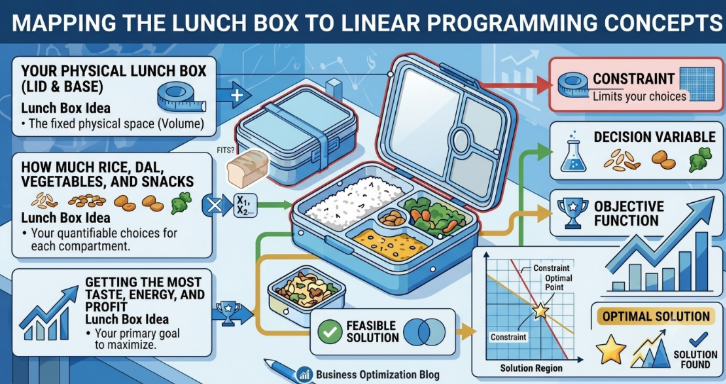
Mapping the lunch box to LP concepts
| Lunch box idea | LP term | What it means |
|---|---|---|
| The size of your lunch box | Constraint | A limit you cannot cross, such as available space |
| How much rice, dal, and vegetables you pack | Decision variable | The amount of each item you are allowed to choose |
| Getting the most taste and energy from the box | Objective function | The goal you are trying to maximize or minimize |
| A combination of food that fits in the box | Feasible solution | Any packing plan that breaks no rule |
| The single best combination of food | Optimal solution | The feasible plan that gives the highest score |
Once you can identify a constraint, an objective, and a decision variable in a lunch box, you can identify them in a balance sheet, a delivery schedule, a production plan, or a staffing model.
03How Linear Programming Finds the “Best” Solution
Any packing plan that fits inside the lunch box and follows every rule is a feasible solution. You could pack mostly rice, mostly vegetables, or a balance of rice, dal, and vegetables. Many combinations may fit all of them feasible, but not equally good.
Linear programming exists because not all feasible plans are optimal.
Some combinations give more nutrition and taste per unit of space than others. Rice may fill you up but add less protein; dal may add protein but take more space; vegetables may improve nutrition but not provide enough energy alone. The LP solver evaluates these trade offs and identifies the combination that gives the highest value while staying within the limits. That winning combination is the optimal solution.
04Where Linear Programming Is Used in the Real World
The lunch box example scales directly into business problems the company is simply packing a bigger, more complicated box, often with thousands or millions of decision variables instead of three.
| Industry / case | What gets optimized | Real example |
|---|---|---|
| Supply chain & logistics | Delivery routes, warehouse stock, fleet usage | Reducing fuel cost while meeting every delivery deadline |
| Workforce scheduling | Staff shifts, working hours, overtime allocation | Covering every shift with the fewest overtime hours |
| Manufacturing | Production mix and machine capacity | Deciding how many units of each product to build with limited materials |
| Finance | Investment allocation | Spreading money across assets to balance risk and return |
A familiar example is e-commerce packaging optimization, where companies choose the best-fitting box from a standard set of 10–15 sizes for every order, minimizing empty space, packaging scrap, and shipping cost while ensuring all products fit safely. Food delivery platforms such as Swiggy and Zomato solve a similar problem when selecting standard packaging for different combinations of ordered items, balancing cost, efficiency, and customer experience.
05Why Linear Programming Is Still Relevant in the Age of AI
Linear programming is not an outdated technique that AI has replaced it is one of the foundations of modern optimization. Machine learning predicts what is likely to happen next; linear programming decides what to do once you have that prediction. In practice, the two work together.
Machine learning answers
- “What is likely to happen?” forecasts next week’s demand for each product
- Excellent at prediction and pattern recognition
- Often a black box hard to explain why
Linear programming answers
- “What should we do about it?” decides trucks, workers, shelves, and production slots to meet that demand at lowest cost
- Delivers a provably optimal decision
- Fully explainable shows which constraint bound the result and why
Neither replaces the other; they solve different parts of the decision-making problem. LP also offers something many modern AI models cannot: full explainability. A solver can show which constraint prevented a better result and why each decision variable received its final value. When a CFO asks “Why this plan and not that one?”, a linear programming model gives a precise answer where a black-box neural network usually cannot.
06Key Takeaways: Thinking Like an Optimizer
Linear programming becomes easier once you learn to see the structure behind the problem.
- Identify the three ingredients first decisions, goal, and rules. Ask what you can control, what you are trying to improve, and what limits cannot be violated.
- Treat every limited resource as a constraint. Time, space, budget, labour, inventory, and machine capacity define what is realistically possible.
- The most attractive option alone is rarely the best overall. Once constraints apply, trade-offs decide the outcome.
- Use LP when you need a provably optimal and explainable answer. When inputs are uncertain, combine LP with forecasting models.
- The same lunch-box logic scales from a single meal to a billion-dollar supply chain only the number of variables changes.
Conclusion
Linear programming sounds technical, but the idea behind it is something you already use whenever you pack a lunch box, plan a trip, or manage a monthly budget. The real skill is not the math it is learning to clearly define your decisions, your goal, and your limits before you act.
The next time you face a problem with limited resources and a clear goal, frame it like a lunch box problem and ask: What can I choose? What am I trying to maximize or minimize? What limits must I respect? That is the beginning of optimization thinking and it scales from your kitchen counter to the boardroom.
Frequently Asked Questions
What is linear programming in simple words?
Linear programming is a way to choose the best mix of options when resources are limited and the relationships between choices and outcomes are linear. It finds the combination that gives the most value without breaking any rule.
Why is it called “linear” programming?
Because the objective and constraints behave in straight-line, proportional ways. If one portion of rice uses one unit of space, two portions use two units the relationship increases consistently.
How is linear programming different from machine learning?
Machine learning predicts an unknown value, such as next month’s demand. Linear programming decides the best action to take when goals, limits, and inputs are known. They solve different problems and are often used together.
What is a real-life example of linear programming?
Packing a lunch box is a simple example. A larger business example is a delivery company deciding how many trucks to send on which routes so every customer is served at the lowest possible fuel cost.
Do I need advanced math to understand linear programming?
No. The core idea decisions, a goal, and rules can be understood through everyday examples like packing a lunch box. Advanced mathematics becomes important only when you start building and solving models in code.
What is a common mistake people make with linear programming?
The most common mistake is missing a real-world constraint a staffing model that ignores rest hours, or a warehouse model that ignores storage limits. When a model skips an important constraint, it may recommend a plan that looks optimal on paper but cannot be implemented in real life.

Have a bigger lunch box to pack?
When your constraints run into thousands of variables, ORMAE builds the optimization models that find the provably optimal plan.
Talk to ORMAE